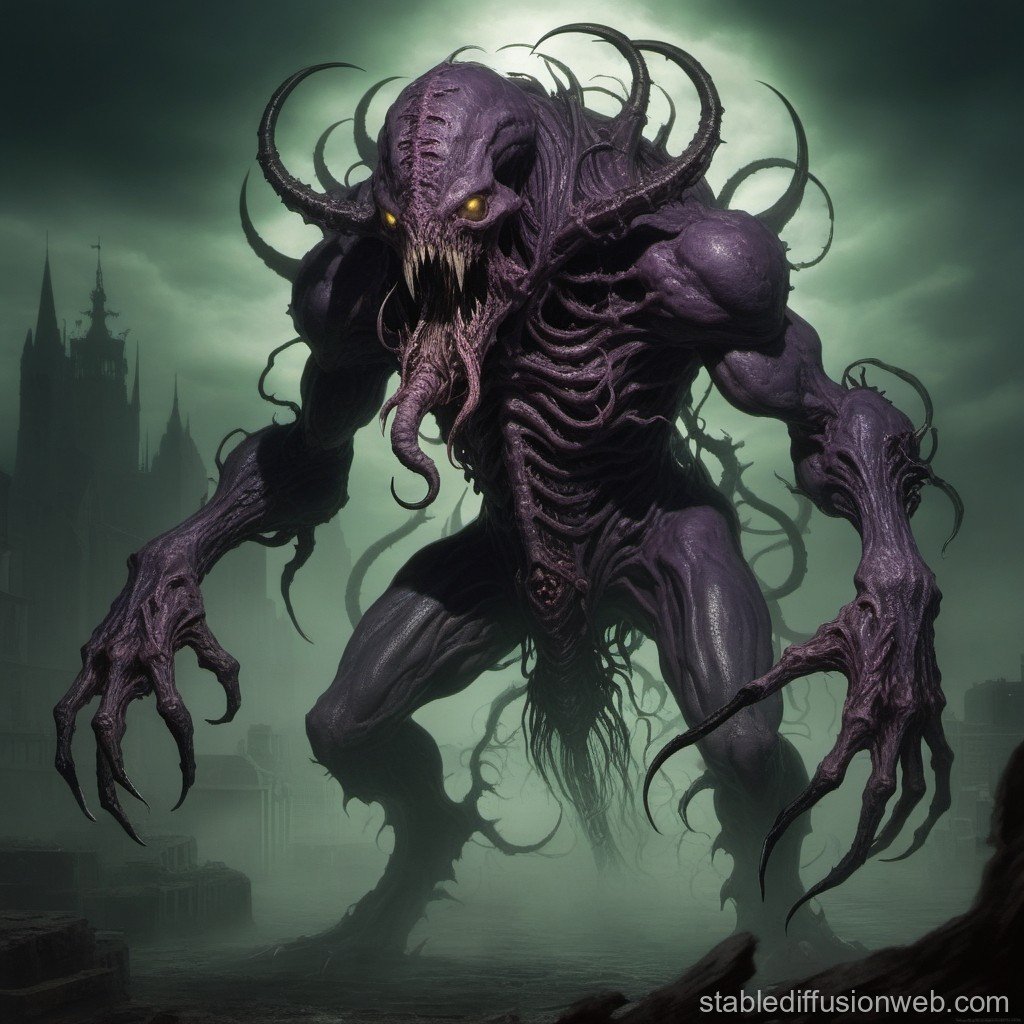
The flickering torch casts long, distorted shadows, revealing ancient carvings that twist the mind, hinting at entities best left undisturbed. Yet, here you are, poised on the precipice of creation, tasked with giving voice — or perhaps, a chilling echo — to the incomprehensible. Naming a horror, especially an eldritch abomination, isn't just about stringing letters together; it's about crafting a whisper of the void, a sonic key that unlocks primal dread. It's about evoking something so fundamentally wrong, so alien, that merely uttering its name can fray the edges of sanity.
Forget simple monster monikers. We're talking about beings whose very existence defies human logic, creatures that existed before time and space as we know them, "conform[ing] to no rules, patterns or laws as the human race recognises them," as the Monster Fandom Wiki aptly puts it. Giving these entities a name isn't just a label; it's a profound act of world-building, a terrifying incantation that imbues your creation with an identity both unsettling and unforgettable.
At a Glance: Crafting Names That Whisper Madness
- Go Beyond the Obvious: Eldritch names shouldn't just sound scary; they should feel alien, ancient, and incomprehensible.
- Leverage Phonetics: Use harsh consonants, unusual vowel combinations, and deliberately awkward pronunciations to create a sense of discomfort.
- Tap into Ancient Roots: Look to dead languages, obscure mythologies, or historical oddities for inspiration, then twist them.
- Embrace the Abstract: Names can convey impossible concepts like entropy, cosmic indifference, or forgotten knowledge.
- Avoid the Mundane: Steer clear of names that sound too human, too cute, or too easily understood.
- Iterate and Test: Read names aloud, get feedback, and ensure they resonate with the cosmic horror you're aiming for.
- Don't Overcomplicate: While unsettling, a good eldritch name should have a memorable, if disturbing, rhythm.
The Power of an Unspeakable Name: Why It Truly Matters
In horror, particularly cosmic horror, the unknown is your most potent weapon. A well-chosen name doesn't explain; it suggests. It doesn't clarify; it corrupts. It's the first ripple of madness, a linguistic echo of something vast, indifferent, and utterly hostile to human existence. Think of Lovecraft's pantheon: Cthulhu, Yog-Sothoth, Azathoth. These aren't just sounds; they are incantations, gateways to realms where reality frays and sanity shatters.
A strong eldritch name serves multiple crucial purposes:
- Establishes Cosmic Scale: It immediately communicates that this isn't just another monster. This is an entity of immense, unfathomable power and antiquity.
- Evokes Dread and Mystery: The strange phonetics, the implied meaning (or lack thereof), and the sheer alienness of the name create an instant sense of unease and curiosity.
- Builds Lore and Atmosphere: Names like "Nyarlathotep" hint at ancient civilizations, forgotten cults, and unspeakable histories, enriching your world with minimal effort.
- Increases Memorability (Paradoxically): While difficult to pronounce, the unique quality of eldritch names often makes them stick in the mind, echoing long after the story is told.
- Sets the Tone: The very sound of the name prepares your audience for the unique brand of horror they are about to encounter. It's the first taste of the void.
What Are We Really Naming? Understanding Eldritch Abominations
Before you can craft the perfect name, you need to understand the beast — or rather, the un-beast. Eldritch abominations aren't your typical goblins or vampires. As our research notes, they are "beings whose raison d'être and/or appearance, the human mind cannot even begin to comprehend." They are cosmic entities, often from dimensions beyond our own, operating on principles utterly alien to human understanding.
Think about these core characteristics that influence their naming:
- Incomprehensibility: Their forms, motivations, and origins are beyond human grasp. Their names should reflect this inability to categorize or fully articulate.
- Ancientness: Many have existed for eons, pre-dating life on Earth. Their names should carry a weight of forgotten time.
- Cosmic Indifference: They don't hate humanity; they simply exist on a different plane, viewing us as less than ants, if they perceive us at all. Their names often convey this vast, uncaring scale.
- Alien Biology/Physics: They don't conform to our biology or physics. Their names might hint at impossible geometries, non-Euclidean structures, or sensory experiences that don't exist in our reality.
- Corrupting Influence: Their presence or mere thought can drive mortals mad. A good name should feel like a sliver of that corrupting influence.
- Multiple Manifestations/Forms: Some eldritch entities don't have a single, stable form. Their names might be a title, a cultic utterance, or a sound that barely approximates their essence.
The Architect's Toolkit: Core Naming Principles for Cosmic Horror
Crafting these names is less about picking words and more about manipulating language itself to evoke a sense of the profoundly other. Here are the key principles:
1. Phonetic Alienation: Sounds That Grind Against the Soul
This is arguably the most critical aspect. Eldritch names often sound guttural, sibilant, discordant, or simply wrong to the human ear.
- Harsh Consonants: Think 'k', 'g', 'z', 'x', 'th', 'sh'. Sounds that feel sharp, heavy, or like something tearing. (e.g., Cthulhu, Azathoth)
- Unusual Vowel Combinations: Avoid common English vowel patterns. Combine vowels in ways that feel foreign or hard to pronounce smoothly. (e.g., Yog-Sothoth, Y'golonac)
- Glottal Stops and Aposiopesis: The use of apostrophes (like in "Y'ha-nthlei") doesn't always denote missing letters but can imply a break in sound, a gasp, or a non-human phoneme. It creates a stuttering, halting quality.
- Dissonance and Repetition: Clashing sounds or the repetition of an unpleasant sound can be very effective.
- Uncertain Pronunciation: A truly great eldritch name leaves you slightly unsure how to pronounce it, making you feel like you're misinterpreting something profound.
2. Linguistic Corruption: Twisting the Familiar into the Terrifying
Take elements of real language and warp them until they're unrecognizable or carry new, sinister implications.
- Obscure or Dead Languages: Latin, Greek, Sumerian, Akkadian, Old Norse, Gaelic, and other ancient tongues offer a vast lexicon of evocative words. Take a word like 'maledictum' (cursed in Latin) and twist it into 'Maldektoth' or 'Maledra'.
- Archaic or Obsolete English: Words like 'eldritch' itself, or 'wight,' 'blight,' 'gloaming,' 'chthonic,' 'charnel.' These words already carry a historical weight of dread.
- Misspellings and Typographical Errors: A subtle change can create a profound sense of wrongness. 'Doom' becomes 'Doomm,' 'Shadow' becomes 'Sha'doww.' It feels like reality itself is glitching.
- Hybridization: Combine root words from different languages, or even just disparate English words, to create something new and unsettling (e.g., 'Gloom-Weaver,' 'Void-Screamer').
3. Conceptual Horror: Names That Hint at Impossible Truths
Sometimes the horror isn't in the sound, but in the idea the name conveys.
- Abstract Nouns as Proper Nouns: Naming an entity "Despair," "Entropy," "Oblivion," "Null," or "Absolution" (with a sinister twist) can be incredibly powerful, making the concept itself a living, malevolent force.
- Descriptive but Alien: Use words that describe a horrifying aspect, but combine them in ways that suggest something beyond our understanding. "The Thousand-Fold Blight," "The Star-Spawned Mire."
- Paradoxical Names: A name that seems to contradict itself can heighten the sense of incomprehensibility. "The Quiet Scream," "The Living Stillness."
4. Sensory Overload/Deprivation: Evoking What Cannot Be Perceived
Names can hint at experiences that defy our senses.
- Visual Impossibility: Names suggesting impossible colors (e.g., "The Amaranthine Blindness"), geometries (e.g., "The Angles of Y'gorr"), or textures.
- Auditory Terror: "The Cacophony from Beyond," "The Silent Cry."
- Unspeakable Tastes/Smells: While harder to convey directly in a name, you can imply it with words suggesting decay, alien biology, or corruption.
Crafting Your Abomination's Moniker: A Step-by-Step Guide
Ready to delve into the depths? Here’s a practical process to forge names that will chill your audience to the bone.
Step 1: Define Your Horror's Core Essence
Forget physical appearance for a moment. What is its fundamental nature? Its domain?
- What does it represent? (e.g., ultimate entropy, forgotten knowledge, cosmic hunger, dimensional chaos, primal void).
- What is its primary "action" or influence? (e.g., devours realities, spreads madness, seeds cosmic parasites, dreams universes into existence).
- What is its most terrifying aspect? (e.g., its sheer size, its indifference, its ability to twist minds, its age, its formlessness).
- What kind of cult would worship it? (e.g., flesh-eating primitives, arcane scholars, suicidal nihilists). This can influence the name's linguistic flavor.
Example: An entity that lives in the gaps between realities, feeding on forgotten memories and slowly erasing history. Its terrifying aspect is its silent, inexorable consumption of existence itself.
Step 2: Brainstorm Core Concept Words and Phrases
Based on Step 1, jot down keywords. Don't self-censor.
- Example Keywords for our entity: Void, gap, tear, unravel, oblivion, memory, echo, silence, consume, forgotten, unmake, end, whisper, shadow, drift, entropy, null, time, maw.
Step 3: Deconstruct, Mutate, and Reconstruct
Now, start playing with those words. This is where the magic (or the madness) happens.
- Combine: Try putting two unrelated words together. "Void Maw," "Memory Shadow," "Echo Null."
- Translate: Use an online translator (with caution) for those keywords into dead or obscure languages. Don't use the direct translation; just use it as a sound bank.
- Example: "Void" (Latin: inanitas), "Memory" (Greek: mneme), "End" (Sumerian: nita).
- Twist & Misspell: Deliberately alter spellings. Add or remove letters.
- Example: "Obh-liv-yon," "Mnem-oth," "Ny'tah."
- Add Prefixes/Suffixes: Use common horror/fantasy suffixes or invent your own.
- Common examples: -oth, -goth, -thul, -ol, -ugg, -zath, -ka, -’ai, Mal-, Necro-, Ab-, Omni-.
- Example: "Mnemoth-Ka," "Obh-liv-Zath," "Ny'tah-goth."
Step 4: Leverage Linguistic Tricks and Tools
This is where you apply the phonetic and linguistic principles.
- Phonetic Play:
- Harsh sounds: Focus on hard 'c' (k), 'g', 'z', 'x', 'q'.
- Sibilance: Emphasize 's', 'sh', 'z' for a whispering, slithering effect.
- Guttural sounds: Names that feel like they're coming from deep in the throat.
- Difficult consonant clusters:
Ng', 'thl', 'kth', 'shthare great. - Example: For our entity:
Xy'loth,Gna'kar,Thul-Nog. - Embrace the Apostrophe/Hyphen: Use them to break up words, indicate strange pronunciations, or suggest non-human vocalizations. They add mystery.
- Example:
Xy'loth-ka,Gna'kar-Thol,Thul-Nog-Mnem. - Compound Names & Titles: Combine multiple elements. Eldritch entities often have a "true name" and then many cultic titles.
- Example: "Xy'loth, The Unraveller of Paths," "Gna'kar-Thol, Eater of Silent Echoes."
- Abstract to Concrete: Take abstract concepts and turn them into proper nouns.
- Example: "Entropy itself as Entropax," "Oblivion as Oblivarax."
Step 5: Test the Sound and Feel
This step is critical. Read your names aloud, multiple times. How do they feel on the tongue?
- Does it sound alien? Or does it sound like a misspelling of a normal word?
- Is it memorable, even if unpronounceable? Can people consistently mispronounce it in the same unsettling way?
- Does it evoke the right kind of dread? Does it fit the specific horror of your creature?
- Get Feedback: Ask others to pronounce it, without giving them context. Note their reactions.
Example iterated names for our entity: - Original brainstorm: Void, memory, unmake, echo.
- First pass: Void-Mnem, Un'echo, Thule-Memory. (Too simple)
- Adding phonetic corruption, ancient roots, apostrophes:
- Mnemoxxar: Combines 'memory' (mneme) with harsh 'x' and 'ar'.
- Xyl'oth-Ghul: Suggests 'void'/'darkness' with a guttural, ancient sound.
- V'orlagh: A short, sharp name with an apostrophe and a sound that could be a corrupted "void" or "vortex."
- The Chronosynclastic Infundibulum: A more descriptive title, leaning into scientific-sounding horror, suggesting a place or a process rather than a single being, but still evocative.
Examples of Effective Eldritch Names (and Why They Work)
Let's dissect some classics and apply our principles:
- Cthulhu:
- Phonetics: Hard 'C', 'thl' cluster, 'hu' ending. It's difficult to pronounce consistently, often described as "a guttural croaking."
- Alienness: Doesn't resemble any common word.
- Impact: Immediately evokes images of vast, sleeping aquatic horror.
- Azathoth:
- Phonetics: Hard 'A's, 'z', 'th', 'oth' ending. Sounds chaotic, cosmic, a little like a sneeze of creation.
- Concept: "The Nuclear Chaos," "Daemon Sultan." The name itself is a vortex of sound.
- Impact: Represents ultimate, mindless cosmic indifference, the source of all things.
- Yog-Sothoth:
- Phonetics: 'Yog' (guttural, ancient), 'Soth' (sibilant, cold), 'oth' (familiar eldritch ending). Hyphen suggests a compound, perhaps disparate forms.
- Concept: "The Key and the Gate," "The All-in-One and One-in-All." The name hints at impossible knowledge and interdimensional travel.
- Impact: Implies a being of vast, interconnected cosmic consciousness, existing everywhere and nowhere.
- Nyarlathotep:
- Phonetics: Longer, more complex. 'Ny' (nasal), 'lar' (rolling), 'tha' (breathless), 'tep' (sharp). Sounds vaguely Egyptian, yet utterly alien.
- Concept: "The Crawling Chaos," messenger of the Outer Gods.
- Impact: Evokes ancient, insidious evil, often taking human-like forms, a deception within the horror.
- Shub-Niggurath:
- Phonetics: Harsh 'Sh', 'b', 'nigg' (controversial, but phonetically impactful), 'u', 'rath' (guttural).
- Concept: "The Black Goat of the Woods with a Thousand Young." Fertility and horror intertwined.
- Impact: Primal, chthonic, monstrous fecundity.
These names succeed because they aren't just labels; they are carefully constructed sonic and conceptual weapons that prime the reader for unspeakable horrors.
Beyond Manual Crafting: Harnessing Digital Assistance
Sometimes, even the most seasoned horror writer needs a spark, a random jolt to break through creative blocks. This is where modern tools can be incredibly useful.
Tools like an eldritch abomination name generator can offer a fantastic starting point, serving as a creative partner in your naming quest. They're designed to produce "unique and unsettling names for mysterious and terrifying creatures from beyond our world," according to insights into these generators. Their main features often include automatic name generation, producing "eerie and creative names" on demand, and sometimes even customization options to adjust the style or randomness of the output.
You might use such a generator to:
- Kickstart Brainstorming: If you're completely stuck, a few generated names can provide a direction.
- Discover Unexpected Combinations: The randomness can sometimes stumble upon truly unique and effective phonetic pairings you hadn't considered.
- Generate Volume: When you need many names for a pantheon of lesser horrors or minor cult figures, a generator can quickly provide options.
- Test Phonetic Concepts: Input some desired sounds or prefixes and see what the generator combines them with.
Remember, a generator is a tool, not a replacement for your creative intellect. Use its output as raw material, refine it, twist it further, and make it your own. It's an excellent way to add "atmospheric flavor to dark fantasy or cosmic horror projects," as described. If you're looking for an even broader array of options, consider using a comprehensive monster name generator to inspire your creations, which might include categories or elements you hadn't initially considered.
Pitfalls to Avoid When Naming the Unnameable
Even with the best intentions, it's easy to stumble into common traps. Beware these pitfalls:
- Too Human or Mundane: A name like "Fred the Destroyer" or "Mr. Snuggles" (unless used for ironic, unsettling effect) instantly deflates the horror. Avoid anything that sounds too much like a person, pet, or common object.
- Too Simplistic or Obvious: "The Evil Monster" or "Dark Lord" lacks imagination and depth. Eldritch names should be nuanced, even in their horror.
- Trying Too Hard to Be Unpronounceable (and Failing): There's a fine line between "unsettlingly difficult" and "actually impossible to vocalize." The goal is simulated unpronounceability, creating a sense of alien sounds, not a jumble of consonants no human mouth can form. If you can't even get close, it loses impact.
- Accidental Comedy: Be careful with sounds or combinations that might inadvertently sound like something silly or harmless in another context. Read names aloud to unsuspecting friends!
- Lack of Thematic Resonance: The name should feel connected to the creature's nature, even if that connection is abstract. A void-dweller shouldn't have a name that sounds like a fire demon.
- Too Long or Cumbersome: While complex, a name that's overly long or difficult to retain can be counterproductive. Aim for impactful brevity where possible, or memorable complex titles.
- Over-reliance on Tropes: While certain sounds and structures are effective, blindly copying Lovecraftian names without understanding why they work can lead to generic results. Develop your own flavor.
Refining Your Abomination's Identity: The Iteration Process
Naming isn't a one-and-done task. It's an iterative process of creation and refinement.
- Generate Multiple Options: Don't settle for the first decent name. Aim for a shortlist of 5-10 strong contenders.
- Integrate into Lore: Does the name fit naturally within your world's history, cults, and legends? Do any characters struggle with its pronunciation, or is it whispered in hushed tones?
- Read Aloud, Again and Again: Say the name in different emotional registers: a terrified whisper, a cultic chant, a scholarly declaration. Does it hold up?
- Seek Fresh Eyes (and Ears): Share your names with trusted readers or fellow creators. Their unbiased feedback is invaluable. Do they find it scary? Confusing? Memorable?
- Live with It: Sometimes, a name needs to sit with you for a while. Let it marinate in your subconscious. Does it still feel right a week later?
- Context is King: How is the name introduced? Is it found on a crumbling scroll, whispered by a madman, or carved into the flesh of a victim? The presentation can enhance even a good name.
Frequently Asked Questions About Naming Cosmic Horrors
Let's address some common queries that arise when staring into the linguistic abyss.
Q: Should Eldritch names always be unpronounceable?
Not necessarily unpronounceable, but rather difficult, alien, and unsettlingly ambiguous in pronunciation. The goal isn't to create a gibberish string of letters, but to create sounds that grate against human phonetics. Think of it as a simulated phonetic assault, suggesting a language from a realm beyond human comprehension. A slight hesitation, a clunky cluster of consonants, or an uncertain vowel sound is often more effective than utter nonsense.
Q: Can I use real-world mythology or obscure languages as direct sources?
You absolutely can, and often should, use them as inspiration. However, avoid direct copying. Take elements – specific words, prefixes, sounds, or concepts – and corrupt them. Twist their spellings, combine them with other roots, or attach them to new, horrifying meanings. This adds a layer of ancient authenticity without making your entity sound like a borrowed deity. The key is mutation, not mere translation.
Q: How many names should my abomination have?
This depends on the entity and its role. A powerful, ancient abomination might have:
- A "True Name": Often complex, secret, and rarely uttered, possessing immense power.
- Cultic Titles/Epithets: Names given by its followers, often descriptive of its perceived attributes (e.g., "The Devourer of Stars," "The Nightmare Weaver").
- A "Common Name" or Designation: What unwitting mortals might call it before understanding its true nature (e.g., "The Shadow in the Lake," "The Thing from Beyond").
Having multiple names can add depth, mystery, and a sense of evolving understanding (or misunderstanding) of the horror.
Q: What if my name sounds silly to some people?
Humor is subjective, and what one person finds terrifying, another might find amusing. The best you can do is test your names with a diverse group, especially those who appreciate the genre you're writing in. If a significant number of your target audience finds it unintentionally funny, it's probably best to go back to the drawing board. Pay attention to regional slang or common idioms that might inadvertently create a humorous association.
Your Gateway to the Nameless
Generating truly terrifying Horror and Eldritch Abomination Names is a craft that blends linguistics, psychology, and a healthy dose of imagination. It's about more than just a label; it's about invoking a primal dread, a whisper of the cosmic horror that lies just beyond the veil of our reality. By understanding the nature of these unspeakable creatures and applying deliberate naming principles, you can imbue your creations with identities that resonate with profound, unsettling power.
So, take a deep breath, delve into the depths of your imagination, and begin to articulate the inarticulate. Your audience awaits, trembling, for the sound of what cannot be named.